
SHAMSUR RAHMAN: A PEN AGAINST THE GUN
SHAMSUR RAHMAN: A PEN AGAINST THE GUN
A FILM BY AMIRUL ARHAM
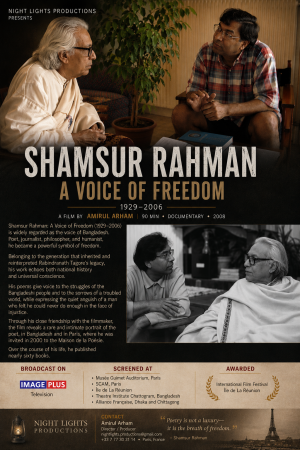
Through the voice and poetry of Shamsur Rahman, the film tells the story of Bangladesh’s independence, the suffering of its people, fundamentalism, and the world today, using archival footage of the country’s Liberation War, as well as political and cultural demonstrations. The film is also an intimate portrait of a great poet, offering a glimpse into his world and his work.
Shamsur Rahman (1929–2006) was the voice of Bangladesh. A poet, journalist, and activist, he was also a voice for freedom. He belonged to a generation of young poets who drew inspiration from the legacy of Tagore. His poems evoke the history of his country, the suffering of Bangladeshis, and that of the wider world, against which he lamented his inability to do more.
While he was still a student, director Amirul Arham met the poet in 1975. The deep friendship that developed between the two men over the years allows us to discover Shamsur Rahman in an intimate setting, both in Bangladesh and in Paris, where he was invited to the Maison de la Poésie in 2000. He published around sixty books.
Professor Kabir Chowdhury, a writer and literary critic, said following the poet’s death: “The people of Bangladesh will always be inspired by his example in the struggle to establish democracy and human rights, and in the fight against fundamentalism. Although the man is gone, the voice of conscience will continue to be heard.”
“Since our youth, the poet Shamsur Rahman has been a moral guide for us. Listening to all those who suffer and all those who struggle, he has worked for rights and justice. Under these circumstances, it is not surprising that he was regarded as an opponent of the regime and criticized by the state. More seriously, he became a target of fundamentalists and was frequently attacked. Yet intellectuals, students, and young people continued to follow and listen to him.
He was also an important source of support for young poets and writers. In particular, he helped Taslima Nasreen, the Bengali woman of letters who was persecuted by fundamentalists. This is why Shamsur Rahman became a voice for democracy, independence, and freedom.
Shamsur Rahman was also one of the greatest poets of his time. Blending tradition with modernity, his poetry draws inspiration from Bengali mythology and is inventive in its musicality and rhythm.
Until then, no film had been made about this hugely popular poet in Bangladesh and West Bengal, India. For all these reasons, I felt compelled to make a film about Shamsur Rahman.
But my film is more than a portrait of the poet. It is also the story of a country, through its joys and suffering, and a testimony to an intellectual’s struggle for freedom.
Inspired by the tradition of direct cinema, this documentary was made by a small crew, in an intimate atmosphere, in order to preserve the close bond and complicity I shared with the poet, whom I had known for more than thirty years.”
Comments (0)