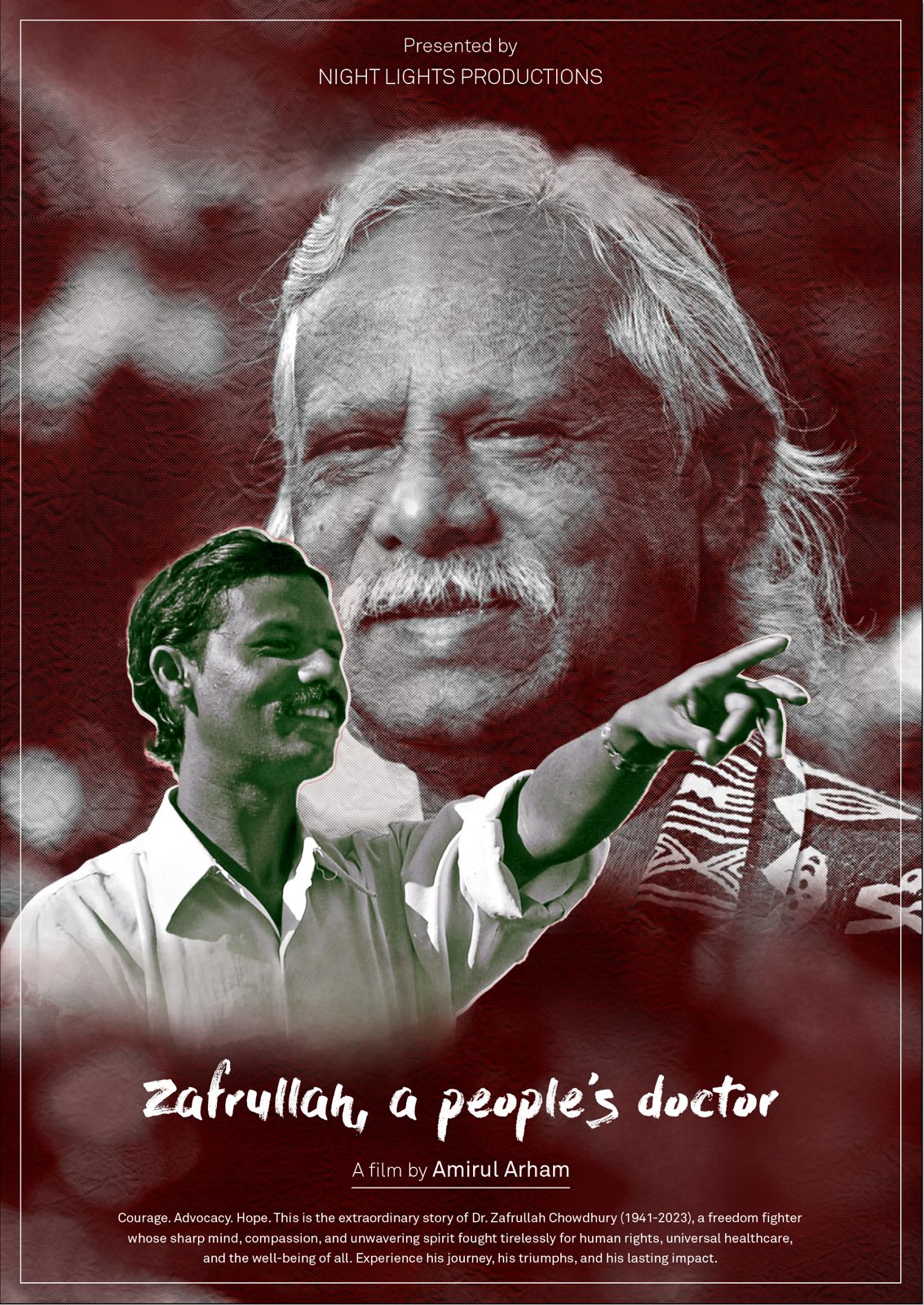
Zafrullah: a people’s doctor A film by Amirul Arham Description: For the welfare of the people of the country, Freedom Fighter Dr. Zafrullah Chowdhury (1941-2023) remains a memorable name in the soil of Bangladesh. Although he did not directly take up arms in the Liberation War, he brought about revolutionary changes by serving wounded freedom fighters, arranging arms for the war, and founding the Gonoshasthaya (Public Health) Hospital to ensure public health care. He was the first to call out many donor-supplied medicines as “unnecessary drugs.” His 1982 Drug Policy not only contributed to public health and economic development in Bangladesh but also influenced health policies in many countries around the world. He firmly believed that women’s independence and empowerment were essential for national development. Accordingly, in all institutions and initiatives under Gonoshasthaya, he prioritised women. A communist—fiery yet compassionate—he was extremely honest and incredibly brave. In this land of class inequality, he fought relentlessly for the fundamental rights of the marginalised and the establishment of democracy, always speaking out boldly for justice. To him, humanity came first. Every person found refuge in him. Even in his final days, suffering from a serious illness and undergoing dialysis, he joined protests with a cannula in his hand, marching against the government with the people’s demands. Our film is about him: “Zafrullah Chowdhury, a People's Doctor.” * * * * * * * * * * * * * * * * * * * * * * * * * * * * * * * * * * * * * * * * * * * * * * * * * * * * * * * * * * * * Pour le bien-être du peuple, le combattant de la liberté Dr Zafrullah Chowdhury (1941-2023) reste un nom mémorable sur la terre du Bangladesh. Bien qu’il n’ait pas pris les armes directement pendant la guerre de libération, il a apporté des changements révolutionnaires en soignant les combattants blessés, en organisant l’approvisionnement en armes, et en fondant l’hôpital Gonoshasthaya pour garantir des soins de santé au public. Il a été le premier à qualifier de nombreux médicaments fournis par les pays donateurs de « médicaments inutiles ». Sa politique pharmaceutique de 1982 a non seulement amélioré la santé publique et l’économie du Bangladesh, mais elle a aussi influencé les politiques de santé dans de nombreux pays à travers le monde. Il considérait que l’indépendance et l’autonomisation des femmes étaient essentielles au développement du pays. En conséquence, dans toutes les institutions et initiatives de Gonoshasthaya, il a donné la priorité aux femmes. Communiste — colérique mais plein de compassion — il était d’une honnêteté remarquable et d’un courage exceptionnel. Dans ce pays marqué par l’inégalité sociale, il a lutté sans relâche pour les droits fondamentaux des marginalisés et pour l’instauration de la démocratie, en parlant haut et fort pour la justice. Pour lui, l’humanité passait avant tout. Toute personne trouvait refuge auprès de lui. Même à la fin de sa vie, gravement malade et sous dialyse, il est descendu dans la rue, canule à la main, pour manifester contre le gouvernement avec les revendications du peuple. Notre film lui est dédié : « Zafrullah Chowdhury, médecin du peuple. »